Canon EOS R5 Mark II for Video: What You Need to Know
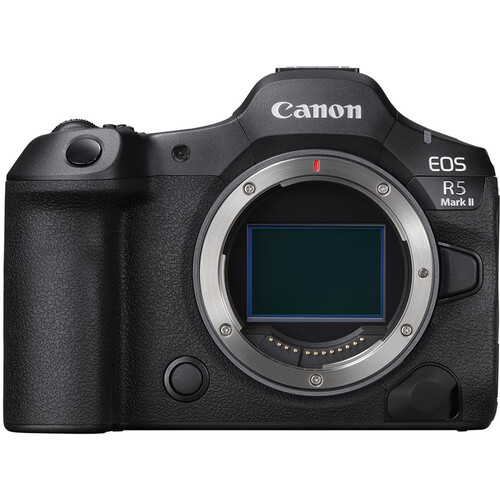
The Canon EOS R5 Mark II isn’t just an update to the beloved R5 mirrorless camera; it stands as the spiritual successor to the renowned EOS 5D series of ‘affordable’ full-frame digital cameras. This includes the legendary EOS 5D Mark II, which was the world’s first DSLR to offer Full HD video capability, significantly changing market expectations for video performance in ‘photography’ cameras. Canon insiders have shared that this model’s success gave the company the confidence to expand aggressively into the digital cinema market.
Although the R5 Mark II’s impressive specifications are often highlighted for photography, it’s equally designed for filmmakers. Here’s a comprehensive look at what this camera offers to videographers.
Canon EOS R5 Mark II Store Links at Amazon, B&H, Adorama.
Read more:
Video Specs
The EOS R5 Mark II supports a wide range of resolutions and frame rates to accommodate various video quality requirements. At its highest setting, the camera can internally record DCI 8K Raw video at up to 60 frames per second. It also introduces a new 4K ‘SRaw’ recording option, supporting frame rates up to 60p. Though Canon hasn’t clarified whether this 4K is downsampled from 8K or subsampled on the sensor, this is something we’ll investigate in our comprehensive review.
When it comes to compressed video, the R5 Mark II can capture 8K, 4K, and Full HD resolutions in both DCI (1.89:1) and UHD (16:9) aspect ratios, using either the full width of the sensor or a slight crop (1.05x). This includes 8K up to 30p, subsampled 4K up to 120p, and subsampled Full HD up to 240p. Additionally, 4K and Full HD resolutions can be captured in both DCI and UHD ratios using a cropped APS-C region of the sensor.
Moreover, when connected to an external recorder via HDMI, the camera can output 8K Raw at up to 30p or 4K Raw at up to 60p, both in a 1.89:1 aspect ratio. We anticipate that this can be encoded as ProRes RAW with future updates from Atomos.
Codecs
The R5 Mark II offers multiple codecs to support its extensive video capabilities. For Raw video, users can choose between Canon’s Raw or Raw Light format. Videos recorded at 50p or higher frame rates utilize the Raw Light format to manage file sizes. There’s also a 4K Raw SRaw option for more manageable file sizes.
To better align with its Cinema EOS line, the R5 Mark II includes Canon’s XF-HEVC S and XF-AVC S compressed video formats, both capturing 4:2:2 10-bit color. The XF-HEVC S format, based on H.265, allows for 4:2:0 8-bit or 10-bit video, while XF-AVC S, based on H.264, offers 4:2:0 8-bit video.
For capturing HDR video, the camera can simultaneously record normal and underexposed frames to preserve highlights in high-contrast scenes. This can be paired with the camera’s PQ picture profile for display on compatible TVs or monitors.
Rolling Shutter
One of the significant enhancements in the EOS R5 Mark II is the inclusion of a Stacked CMOS sensor, which promises better rolling shutter performance, though not as fast as the one in Canon’s flagship R1.
We measured the rolling shutter rate for DCI 8K video at approximately 12.6ms. This is an improvement over the 15.4ms measured on the original R5, making rolling shutter artifacts less noticeable in the new model.
While most stacked sensor cameras don’t capture video using the fastest multi-line readout modes they use for stills, achieving a sub-15ms rolling shutter rate is commendable and reduces the likelihood of visible distortion.
C-Log2
The EOS R5 Mark II is the first Canon mirrorless camera to feature Canon’s C-Log2 gamma profile, aiming to align video capabilities and workflows across Canon’s product line.
C-Log2 captures a wider dynamic range than C-Log3, providing better replication and matching with Canon’s cinema cameras. However, C-Log3 remains available for less demanding scenarios where the extensive dynamic range of C-Log2 isn’t necessary, retaining more data per light stop.
Overheating
The original R5 faced criticism for overheating, especially during 8K recording. The R5 Mark II, while still prone to thermal issues at its highest resolutions and frame rates, includes a new accessory grip with a built-in cooling fan, the CF-R20EP, to address this problem.
Canon states that the R5 Mark II can capture 8K/30p video for up to 26 minutes or 37 minutes with the auto power-off temperature set to high in a 23ºC/73ºF environment. With the accessory fan, these times extend to 106 minutes or 120 minutes or more. For 4K/60p recording, the fan allows for unrestricted recording time.
The CF-R20EP accessory, priced at $400, also includes an ethernet port for fast connectivity and remote operation.
Dual Recording
A new dual recording feature allows the R5 Mark II to capture high-resolution JPEG images while recording video. This feature enables Full HD video capture at up to 30p on one card while capturing UHD 8K (7620 x 4230 resolution) JPEG images at up to 7.5fps on the other.
This feature requires careful optimization of the shutter speed, as it uses the same setting for both photo and video. Additionally, some camera functions, like focus breathing correction, chromatic aberration correction, diffraction correction, and in-camera image upscaling, are disabled in this mode. Dual recording necessitates the new LP-E6P battery for more sustained power.
Video Tools
Beyond its impressive video specifications, the R5 Mark II includes several tools to enhance the video capture experience. Canon has added a waveform display for accurate exposure judgment across the frame and a false color display for visualizing exposure values, making it easier to achieve the correct exposure for specific parts of an image, like skin tones.
On the hardware side, the R5 Mark II now features a full-sized HDMI port, replacing the mini-HDMI port of its predecessor. It also includes a front tally light for indicating recording status and 3.5mm headphone and microphone jacks.
Additionally, the R5 Mark II can pre-capture either three or five seconds of video, which is particularly useful for unpredictable action sequences.
Multi-Function Hot Shoe and Digital/4-Channel Recording
The EOS R5 Mark II incorporates Canon’s multi-function hot shoe, offering compatibility with a range of accessories beyond speedlights. Unlike the original R5, which lacked this feature, it was later introduced on the EOS R3.
For video shooters, the multi-function shoe’s main advantage is its support for digital audio input and 4-channel audio recording.
Summary
The original EOS R5 gained a reputation as a capable video camera, delivering exceptional video quality once its initial overheating concerns were addressed. The R5 Mark II builds on this foundation by addressing previous challenges, such as thermal management with an add-on fan, improving workflow with tools like waveforms and false color, and enhancing capabilities with features like C-Log2 and dual recording.
The result is a camera that excels in both stills and video, potentially serving seamlessly as a B-cam in a production using Cinema EOS equipment. Whether you’re a serious video shooter or an enthusiast eager to explore new horizons, the R5 Mark II offers tremendous potential. We’ll see how it performs in real-world conditions once we receive a production unit and test its autofocus to see how well the stills experience translates to video.
Canon EOS R5 Mark II Store Links at Amazon, B&H, Adorama.
Read more: